

Research & results
Enabling access
GEORyder / Horizon Europe
Enabling access
to GEO.
Reusable orbital transportation technologies. A European research project advancing the journey from GTO to GEO.
400 kg
Small-satellite capacity · up to
8
European partners
TRL 5/6
Target technology qualification
01 / Project overview
From transfer orbit.
To new possibilities.
GEORyder was a Horizon Europe research and innovation project focused on the development and validation of technologies for a reusable orbital transfer vehicle for small satellites of up to 400 kg.
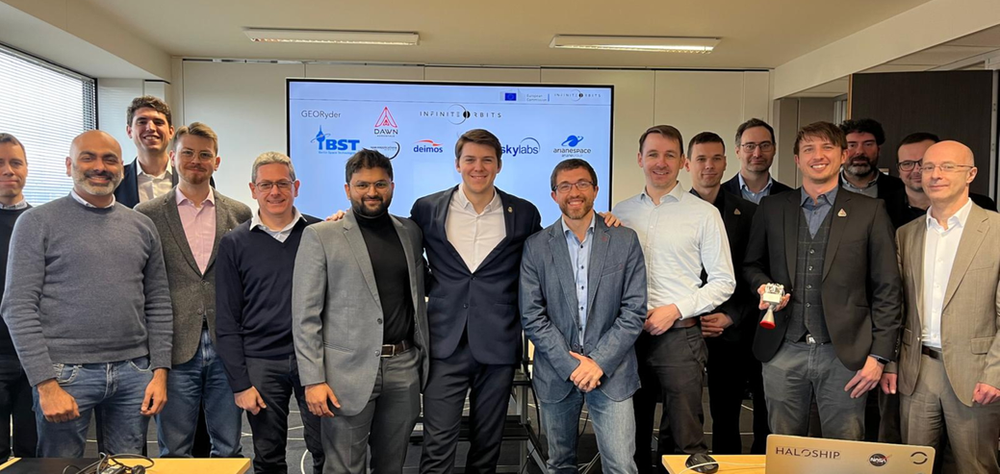
Coordinated by Infinite Orbits, the project brought together eight European partners to develop and test technologies for transfers from Geostationary Transfer Orbit (GTO) to Geostationary Orbit (GEO).
The project focused on a reusable kickstage platform, REACH-compliant green propulsion, autonomous rendezvous capabilities, modular avionics and technologies for in-orbit refuelling.
The project at a glance.
GEORyder – Enabling Access to the GEO Orbit Through a Green Reusable Kickstage Vehicle Allowing Multiple Transfers from GTO to GEO
- Grant agreement
- 101135095
- Programme
- Horizon Europe
- Call
- HORIZON-CL4-2023-SPACE-01
- Coordinator
- Infinite Orbits
The reusable kickstage
One vehicle.
Multiple journeys.
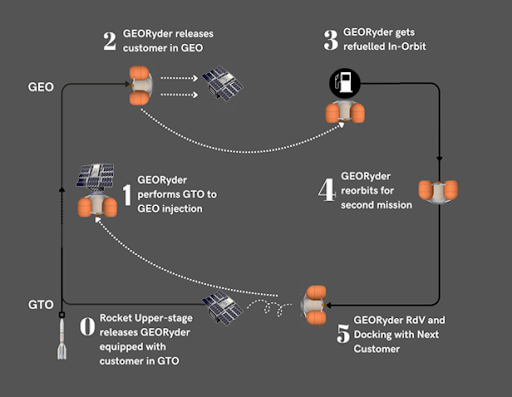
The mission concept combines transfers from GTO to GEO with autonomous rendezvous, satellite release and in-orbit refuelling.
A reusable kickstage returns for a second mission and docks with the next customer.
02 / Project objectives
Six challenges.
One shared ambition.
The general objective of GEORyder was to develop and validate technologies for a reusable kickstage platform for small satellites of up to 400 kg transferring from GTO to GEO, targeting qualification up to TRL 5/6.
01 / Objective
Vehicle Architecture & Design
Full spacecraft structural, thermal and electrical CAD design qualified to Critical Design Review (CDR) standards.
02 / Objective
Industrialisation & Reusability
Modular platform design using more than 75% operational COTS components, supported by assembly workflows and batch-manufacturing plans.
03 / Objective
Sustainable Propulsion
Development and ground testing of a 200 N REACH-compliant green bipropellant thruster and subcooled propellant storage system.
04 / Objective
In-Orbit Logistics & Servicing
Development of fast rendezvous capabilities (hardware and software) and a standardised refuelling interface.
05 / Objective
Agnostic Avionics & Modularity
Development of an agnostic electronics architecture, modular ADCS and software-in-the-loop / hardware-in-the-loop validation up to TRL 5.
06 / Objective
Environmental & Space Debris Impact
Assessment against European and international space debris mitigation standards, including disposal into a GEO + 200 km graveyard orbit.
03 / Project milestones
From kick-off
to qualification.
| Milestone | Date | Objective & Scope | Status |
|---|---|---|---|
| MS1 | 31/03/2024 | Project Kick-Off executed and minutes approved | Achieved |
| MS2 | 31/05/2024 | Definition of mission requirements, specifications and baseline mission profile | Achieved |
| MS3 | 30/09/2024 | Kickstage Preliminary Design Review (PDR) datapack & specification review | Achieved |
| MS4 | 30/11/2024 | Progress Review 1: Preliminary design & qualification test plan review | Achieved |
| MS5 | 28/02/2025 | Medium Term Development Review: Design closure documentation for core technologies | Achieved |
| MS6 | 31/08/2025 & 03/03/2026 | Progress Review 2: Readiness review for technology testing & M24 follow-up | Achieved |
| MS7 | 17/09/2026 | Subsystem qualification reports & technical review | Achieved |
| MS8 | 17/09/2026 | Final reporting approval, project closure meeting & invoicing | Achieved |
04 / Publications & open results
Research, shared.
Progress, made public.
| Title | Authors | Journal number | PID (Publisher version of record) | Link |
|---|---|---|---|---|
| A Guidance Method For Proximity Operations Around a Tumbling Target in HEO | Luca Giorcelli, Mauro Massari, Michele Maestrini | AAS 25-507 | 11311/1297865 | Read paper ↗ |
| Development, Qualification, and In-flight Demonstration of Dawn Aerospace’s Family of 1N–200N Green Nitrous Oxide-Based Bi-Propellant Thrusters | Peter M. van den Berg, Raju Gottimukkala, Maarten S.Schild | 10 | — | View publication ↗ |
| Dual-mode Vision Based Navigation Framework for Autonomous Rendezvous and Docking Operations in Geostationary Transfer Orbits | Annachiara Ippolito, Niccolò Faraco, Michele Maestrini, Mauro Massari | — | 10.82124/CEAS-GNC-2026-067 | Read paper ↗ |
| FROM PROXIMITY OPERATIONS TO CYBER DEFENSE: Simulation Tools for the Next Generation of Space Systems | Niccolò Faraco | — | NA | — |
| GEORyder System-Level Validation of Embedded Guidance and Navigation Algorithms for Autonomous Rendezvous and Docking | Annachiara Ippolito, Luca Giorcelli, Niccolò Faraco, Michele Maestrini, Mauro Massari | — | N-A | — |
| HOTDOCK: Evolution Towards a Space Qualified Standard Interface for In-Space Operations and Servicing Applications | P. Letier, T. Siedel, N. Huot, M. Deremetz | — | View record | View publication ↗ |
| Modular Vision-Based Navigation System for Autonomous Rendezvous and Docking in Geostationary Transfer Orbits | Annachiara Ippolito, Niccolò Faraco, Michele Maestrini, Mauro Massari | — | 11311/1307425 | Read paper ↗ |
| State of Play in the Development and Qualification of the HOTDOCK Standard Interface for On-Orbit Servicing | P. Letier, N. Huot, et al. | — | n a | — |
| GEORyder Close Range Spacecraft Rendezvous Dataset for Vision-Based Navigation in Geostationary Transfer Orbits | Annachiara Ippolito, Luca Giorcelli, Niccolò Faraco, Michele Maestrini, Mauro Massari | — | 10.5281/zenodo.18762445 | View dataset ↗ |
Public resources
Explore the
open resources.
05 / The consortium
Eight partners.
A European endeavour.
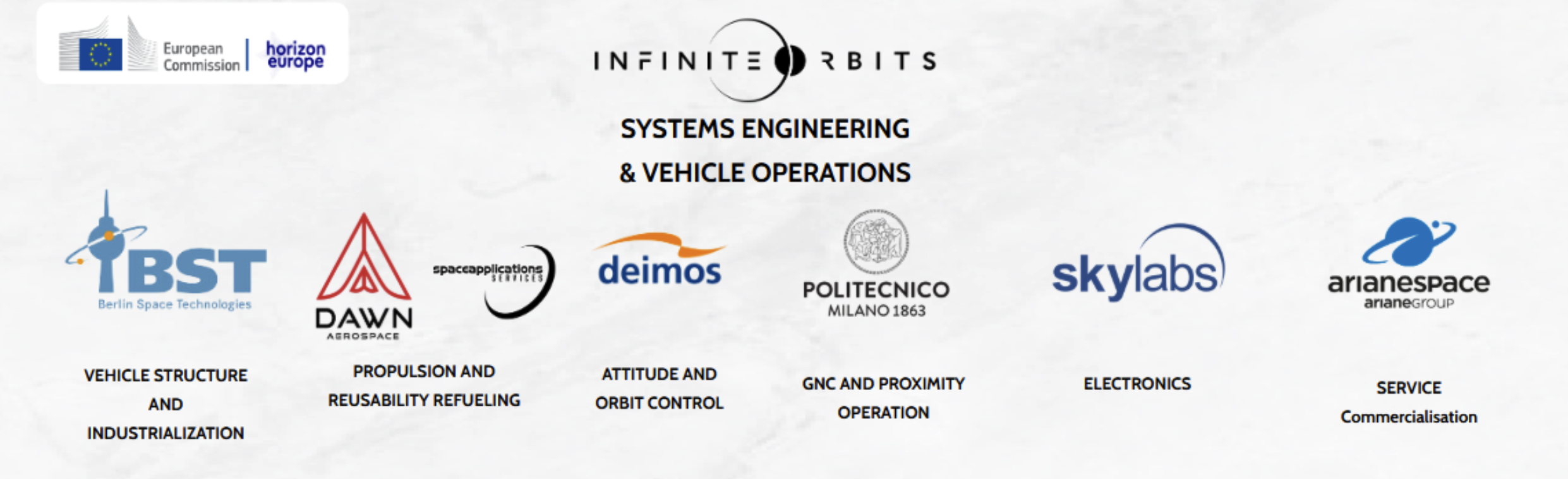
GEORyder brought together eight European partners with expertise spanning spacecraft design, propulsion, avionics, autonomous navigation, refuelling technologies and launch services.
01
Infinite Orbits (Project Lead)
Mission architecture, overall project coordination, system-level trade-offs and GNC integration.
02
Berlin Space Technologies (BST)
Industrialised spacecraft platform, CAD structural design and line manufacturing workflows.
03
Dawn Aerospace (DA)
200 N green bipropellant propulsion subsystem, subcooled storage and fluidic refuelling integration.
04
Deimos / Indra (DM)
AOCS software, flight computer interface and 6DoF guidance algorithms.
05
Space Applications Services (SA)
Standardised HOTDOCK refuelling interface and mechanical connector integration.
06
Politecnico di Milano (PoliMi)
Flight dynamics, trajectory modelling, vision-based navigation and image-processing algorithms.
07
Skylabs (SL)
Radiation-tolerant microelectronics, PicoSkyFT processors and modular OBC hardware architecture.
08
Arianespace (AE)
Launch-service alignment, launcher compatibility analysis and mission payload-envelope validation.
06 / Featured technology
OrbSight-2.
Vision for the mission.
Infinite Orbits’ OrbSight-2 optical camera was used within GEORyder for Space Situational Awareness (SSA) and autonomous Rendezvous & Proximity Operations (RPO), integrating onboard computing capabilities for guidance and navigation.
Key specifications
- Envelope
- 92 × 92 × 210 mm
- Mass
- Approx. 1.37 kg with baffle
- CAN interface
- Dual CAN bus · CANopen
- Ethernet
- Dual 1000BASE-T · UDP/NFS
- Interface options
- RS422 / RS485 and LVDS
- Nominal power supply
- 12 V DC
- Power consumption
- < 8 W peak · < 6 W idle
Qualification & testing
Qualified on the ground.
Built for orbit.
OrbSight-2 underwent environmental qualification activities including TID radiation analysis, modal survey, sinusoidal/random vibration, shock and thermal-vacuum testing.
Hardware-in-the-loop interface validation was conducted with Skylabs’ NANOhpm AOCS OBC and Politecnico di Milano’s vision-based GNC software.
News & project highlights
Continue the
conversation.
For questions regarding GEORyder and its project results:
Rafael dos Santos
Infinite Orbits

EU funding & legal information
Supported by
Horizon Europe.
This project has received funding from the European Union’s Horizon Europe research and innovation programme under Grant Agreement No 101135095 (GEORyder).